TL;DR
After years of building and reviewing hundreds of models, from early-stage startups to PE-backed corporates, I’ve seen the same mistakes come up again and again. The maths alone isn’t always the problem. It’s the structure, the story, and the discipline. Here are the six I see most often, and how to fix them
If you’re looking to raise funding, make sure to avoid these common mistakes.
First, a quick reset: models are not crystal balls
I always start talks with a slide that shows a guy staring into a crystal ball. That’s what most people think modelling is: trying to predict the future. It isn’t. You will be wrong. Whatever the model says, it is statistically certain you won’t hit that number exactly. The point isn’t to be right, it’s to be reasonable, defendable, and confident. That’s what investors and banks look for: can you show that you’ve thought about your business sensibly, can stand behind it and mathematically it hits the right notes?

Mistake 1: Building a model without a real dashboard
When I was on the other side, approving loans, I’d get sent massive models with no summary page, just endless tabs. It was impossible to know where to look first. The best businesses treated the model like a pitch deck: start with the story, then show the proof.
Why it happens: People jump straight to tabs and details. No one stops to ask, “What’s the point of this model?”
Impact: Reviewers drown in numbers. You lose control of the conversation.
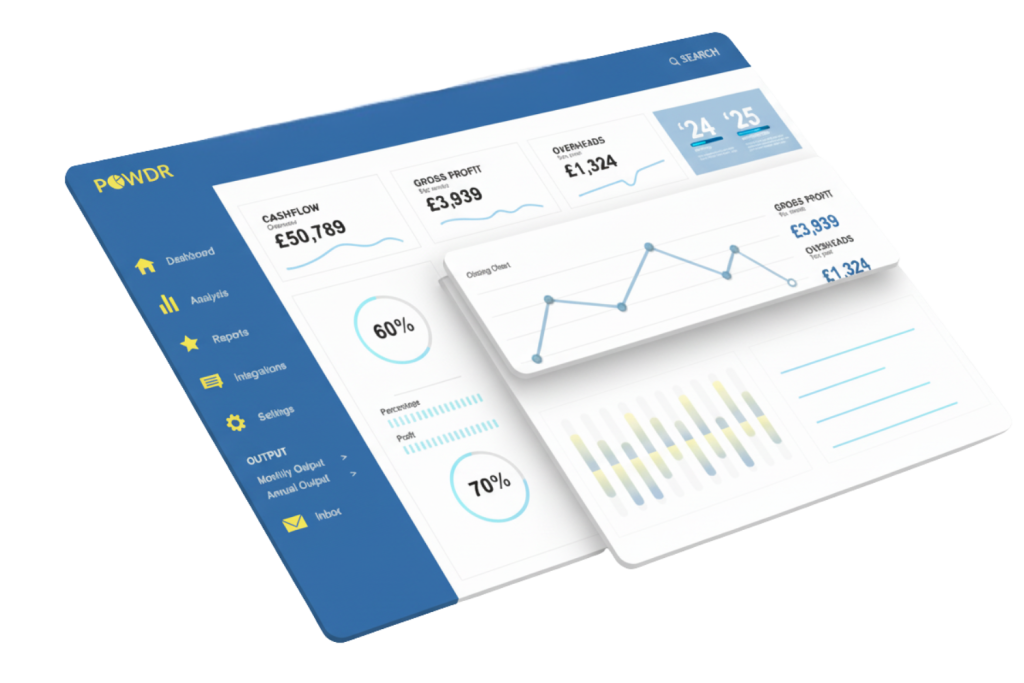
Fix: Create an executive dashboard as the front door to your model.
- Headline charts for revenue, profit, and cash position. This should clearly highlight the funding gap if there is one.
- Core KPIs that actually drive the business and articulate the strategy: price, volume, capacity, margin
- The funding ask: how much, why, and for how long.
- If approaching a bank, highlight bank-friendly metrics: CFADS, covenant headroom, repayment logic
- If raising equity, highlight value drivers: CAC, LTV of customers, breakeven timeline
You need to be able to control the narrative and highlight the numbers that matter most. Don’t make it harder for the person reviewing the model.
Mistake 2: Treating templates as a shortcut
I’ve lost count of how many times I’ve opened a “template” model and found tabs that don’t even apply to the business. People think it saves time; it usually costs them twice as much later when everything breaks.
Why it happens: You download something from Google or reuse a file from a past role. It feels like a harmless, quick-win, but it’s bad practice.
Impact: You inherit redundant lines, wrong flows, and hidden logic. It looks great on first glance, but quickly falls flat of expectations. Worse still, it will be impossible to update effectively.
Fix: Build from your business model outwards. Keep formulas simple and traceable. If you can’t explain a formula in a sentence, it’s too complex.
Rule of thumb: even a big, multi-site business shouldn’t have an Excel model over 10–15 MB. Bigger usually means bad structure, unnecessary lookups, or macros for the sake of it.
Mistake 3: Not including all three statements: P&L, balance sheet and cash flow
In my banking days, I saw businesses come in for loans armed with a simple “money in, money out” sheet. The numbers looked fine, but it doesn’t take into account key details like VAT, timing differences, and working capital. I can’t make a decision without this.
Why it happens: A short-term cash feels practical and natural. But it only tell part of the story.
Impact: You can’t separate profitability from timing. You can’t see the impact of the P&L, your management actions and business strategy. You ask for the wrong type or amount of finance. Or more likely, you just can’t be funded.
Fix: Always build an integrated three-statement model (P&L, balance sheet, cash flow). Shameless plug: Powdr does this for you automatically.
When you can show exactly when cash runs low, how much you need and why it happens, and when the curve turns up again, that’s what gets funded.
Remember: banks want to loan you money, but they need to understand the why behind it.
Mistake 4: Hiding the assumptions
I’ve opened models where assumptions live across 20 tabs with no clear labels. If I have to play detective to find what drives the forecast, it’s not a model; it’s a maze.
Why it happens: Formulas get clever. Tabs multiply. People think complex models look good, when in reality it just make it unnecessarily confusing.
Impact: No one can audit or update it. One change breaks everything.
Fix: Centralise assumptions by theme (e.g Revenue and margin , headcount, expenses , working capital, funding). Use plain English. Link each assumption to the schedule it drives, and add a quick note for source and rationale. Keep maths simple, high-school level is perfect. Complex analysis belongs in a separate calculator.
In Powdr, everything we build is designed to be traceable. You should be able to follow any key number back to its driver in a click or two.
Putting this into practice
If reading this blog has made you question how robust your own model is, you can book a call with our team and we’ll walk through these six mistakes together using your numbers.
Or, if you’d prefer to start independently, you can take our FREE short quiz, answer a few straightforward questions about your model and assumptions, and we’ll send you a personalised report with clear, actionable insights you can apply immediately.