







If you want the direct answer before your next board meeting, here it is: a management forecast is an aspirational roadmap built to motivate your team and hit revenue targets. An investor-ready model is a stress-tested risk assessment built to prove you won’t default on a loan when those targets inevitably slip.
Your internal management forecast is designed to answer the question, “How big can we grow?” It focuses on the Profit & Loss (P&L) statement, gross margins, and sales KPIs.
An investment-ready model is designed to answer, “What happens to our cash if everything goes wrong?” It focuses on the Balance Sheet, working capital cycles, and Debt Service Coverage Ratios.
If you take your internal management forecast, full of aggressive sales targets and flat overhead costs, and hand it directly to a commercial bank, they will reject it. Not because your business is bad, but because you are speaking the wrong language. You are pitching upside to an institution that only cares about downside protection.
Here is how the two models differ, where businesses go wrong, and how to bridge the gap when it’s time to raise capital.
The Quick Comparison
| Feature | Management Forecast | Investment-Ready Model |
| Primary Audience | Internal teams, Board of Directors, Business Owners | Underwriters, Credit Committees, Debt Funds |
| Core Orientation | Optimistic & Target-Driven | Pessimistic & Risk-Averse |
| Financial Focus | Profit & Loss (EBITDA, Gross Margin) | Cash Flow & Balance Sheet (Liquidity) |
| Key Metric | Year-over-Year Revenue Growth | Debt Service Coverage Ratio (DSCR) |
| Structure | Often a standalone P&L | Fully integrated 3-way model |
| Scenarios | Base Case & Stretch Goals | Base Case & Severe Downside |
The P&L obsession vs. the three-way reality
Internally, most businesses run on their Profit & Loss statement. Your sales team celebrates a massive £500,000 contract because it makes the P&L look fantastic.
The management view: “We made £50,000 in net profit this month.” The lender’s view: “You made £50,000 in profit, but your client has 90-day payment terms and your supplier demands payment in 30 days. You have a 60-day cash hole. How are you funding payroll?”
An investment-ready model cannot just be a P&L. It must be a three-way integrated model, meaning your P&L, Balance Sheet, and Cash Flow Statement are mathematically linked. If you forecast a 20% increase in sales, an investment-ready model will automatically increase your Accounts Receivable, tying up cash, and your Inventory requirements, draining more cash.
Hand a bank a standalone P&L without the connecting cash flow mechanics, and they know immediately that you are flying blind on actual liquidity.
Target setting vs. stress testing
When a CEO builds a management forecast, they are setting a target for the company to rally behind. It is inherently optimistic. Business owners often assume that lenders want to see strong growth to prove the business is performing well.
They don’t. Lenders don’t get equity. If your company grows tenfold, the bank still only receives its agreed interest rate. They are not interested in your best-case scenario. They care about your ability to survive a shock.
An investment-ready model must include a robust scenario manager. While your internal team works off the base case, the bank expects a downside case. What happens to your cash runway if a key supplier raises prices by 15%? What if your biggest customer delays payment by 45 days?
At Powdr, we build models that allow you to toggle between scenarios with a single click, demonstrating to a lender that even if revenue drops by 20%, you still generate enough cash to service the debt. Book a demo to see how it works.
The metrics that actually matter to lenders
Your management forecast tracks metrics like Customer Acquisition Cost and Revenue per Employee. These are useful operational KPIs, but a credit committee will largely ignore them.
Lenders are focused on the Debt Service Coverage Ratio (DSCR), the mathematical proof that your operations generate enough cash to pay them back. If your model doesn’t calculate this ratio on a monthly basis, you are making the underwriter do the heavy lifting, which is a reliable way to get your file pushed to the bottom of the pile.
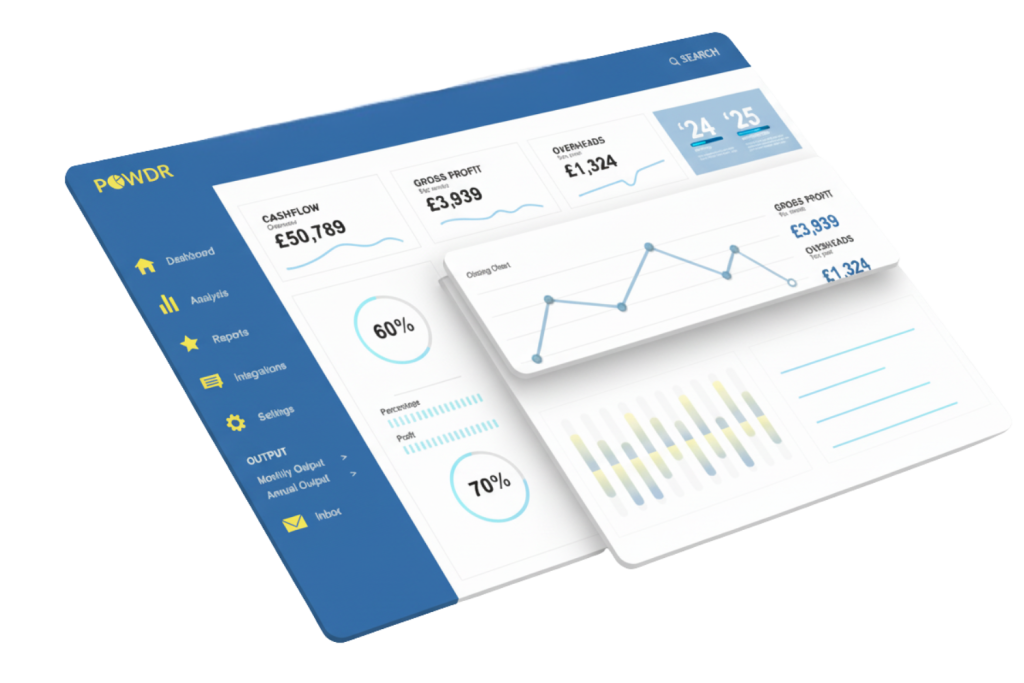
An investment-ready model also proactively tracks covenants. If the bank requires you to maintain a Current Ratio of 1.25x, your financial model should include a dedicated covenant dashboard showing that your projected balance sheet stays within those safety limits over the next three years.
Operational granularity: the detail that builds confidence
Management forecasts often rely on broad assumptions to save time. You might forecast marketing spend as a flat 5% of total revenue. A bank will pick that apart immediately.
A bank-ready model is driver-based. Instead of flat percentages, it shows the underlying drivers of each cost. It breaks down capital expenditure by specific line items, calculates depreciation schedules automatically, and models exact debt amortisation schedules for existing facilities.
If your forecast relies on typed-in numbers rather than formulas linked to core operational drivers, the bank will quickly lose confidence in your financial controls.
Bridging the gap
You shouldn’t need to run two entirely separate financial models, one for your internal team and one for the bank. The goal is a single, unified architecture that serves both.
At Powdr, we take your operational goals and build them into a mathematically rigorous, fully integrated model. Business owners can use the P&L to drive sales teams, while the CFO uses the integrated cash flow statement and scenario manager to negotiate confidently with commercial lenders.
Walking into a funding meeting with a management forecast is like speaking one language to an audience that only understands another. Your management forecast is a tool for inspiration and execution. A lender-ready model is a tool for trust and risk mitigation.
When you sit down with a credit officer, they want to know that you understand worst-case scenarios as well as you understand the upside. Give them a dynamic, three-way integrated model that proves you can handle the pressure, and you won’t just get a loan. You’ll get a financial partner.
Talk to the Powdr team about getting your model lender-ready.