










Growing businesses rarely struggle because they lack ambition. They struggle because their finance function becomes fragmented as they scale.
One provider handles bookkeeping. Another handles compliance. Forecasting lives in spreadsheets. Strategic advice happens occasionally and often disconnected from the underlying data.
Over time, financial information becomes reactive rather than useful, and leadership teams are left trying to connect the dots themselves.
At Powdr, we built a different structure. Instead of layering disconnected services together, we deliver a joined-up finance function through an integrated model that combines operational finance, structured forecasting, and strategic oversight.
Here is how that works in practice.
Why most SME finance functions become fragmented
As SMEs grow, finance evolves in stages rather than through deliberate design.
Early on, compliance is the priority. An external accountant files statutory accounts and VAT returns. Bookkeeping is either done internally or outsourced. Reporting often arrives after the fact and is focused on what has already happened rather than what is coming next.
As revenue increases and complexity builds, leadership teams start asking more sophisticated questions about margin, working capital, runway, and hiring decisions.
However, the finance structure often remains built for a much earlier stage.
This is where fragmentation appears. Data is technically correct but commercially unclear. Forecasting is separate from reporting. Strategic advice is disconnected from operational reality. Decisions begin to rely more on instinct than structured financial visibility.
The issue is not capability. It is structure.
Where operational finance fits in
Before forecasting, funding conversations, or strategic decisions can happen with confidence, the underlying financial data needs to be accurate, structured, and timely.
That is where Your Support Team fits into the model.
 Led by Claire Willmott, a qualified management accountant with experience across large organisations including Co-op, Marks & Spencer Bank and AstraZeneca, the firm was created to bring high-quality commercial finance standards into smaller businesses that often lack access to meaningful management information.
Many SMEs receive accounts long after year-end and struggle to interpret what those numbers mean for the future. Your Support Team bridges that gap by providing structured monthly reporting alongside day-to-day finance operations.
Their work includes transactional finance, accounts payable and receivable, payroll, management accounts, cash reporting, and Xero implementation and optimisation.
They specialise exclusively in Xero and its wider ecosystem, ensuring systems are consistent and data flows cleanly.
Every client works with dedicated contacts who understand the business, rather than a processing-only service. This stage builds the financial hygiene that strategic clarity depends on. Without clean operational finance, forecasting becomes guesswork.
How we structure forecasting and strategic modelling
Once financial information is reliable, the focus shifts from reporting the past to planning the future.
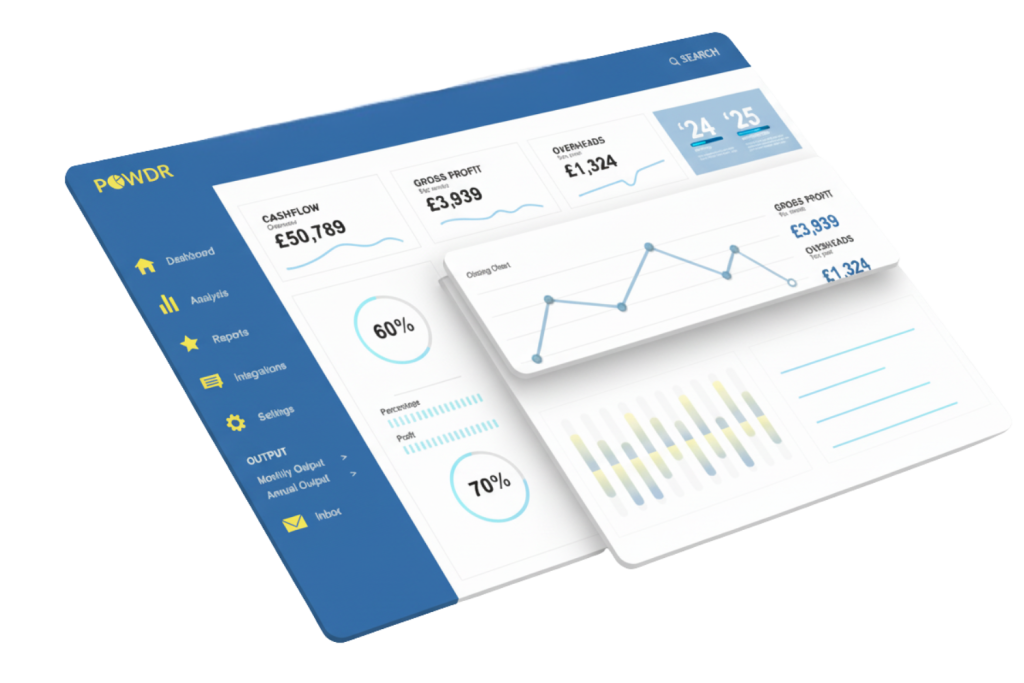
Powdr provides structured three-statement financial modelling that connects profit and loss, balance sheet, and cash flow into one integrated system. This allows leadership teams to see not just performance, but runway, working capital impact, and scenario outcomes in real time.
We built Powdr because too many growing businesses rely on fragile Excel models that are slow to update, difficult to interpret, and disconnected from operational drivers. Forecasts become static documents rather than live decision-making tools.
Our platform replaces that fragility with a structured model built from real-world funding experience. Scenario planning can be adjusted quickly as reality shifts, enabling businesses to stress-test hiring plans, pricing changes, margin pressure, and funding requirements.
Strategic finance should be practical and responsive. It should inform decisions before pressure builds, not after.
When Strategic Oversight Becomes Necessary
As businesses scale, complexity increases. Expansion, acquisition, working capital facilities, margin improvement programmes, or preparation for exit all require more than accurate reporting and live forecasting.
This is where strategic oversight becomes necessary.
 Through our partnership with Chris Howard of PSquared Associates, we extend capability into growth strategy and commercial deployment.
With over 25 years’ experience across multinational corporations and UK SMEs, including time as Managing Director of an engineering business, Chris specialises in translating strategy into measurable outcomes.
His experience includes supporting SME start-ups, scale-ups and exits, securing working capital facilities for expansion, leading due diligence across acquisitions, negotiating multi-year supply contracts with the Ministry of Defence, and delivering process improvement programmes that drive margin growth.
Strategy is not just about direction. It is about execution. Aligning people, process, and financial structure ensures that growth plans are not theoretical but deployable.
What this looks like in practice
When these elements work together, the result is a joined-up finance function.
Operational finance provides clean, structured reporting. Strategic modelling connects those numbers to forward-looking decisions. Strategic oversight ensures growth initiatives are implemented effectively.
Instead of separate providers working in isolation, businesses gain one coordinated ecosystem.
This approach gives SMEs access to the depth of a CFO, FD, FP&A capability, and operational finance support without the cost and complexity of hiring a full in-house team.
On paper, that structure would include multiple senior roles. In reality, many growing businesses need the capability without the permanent overhead.
The model is designed to scale alongside the business rather than constrain it.
Why this model works for growing businesses
The most common finance challenges we see are rarely dramatic failures. They are gradual pressures that build over time.
- Visibility on cash becomes unclear.
- Margins tighten without obvious drivers.
- Forecasts no longer reflect operational reality.
- Existing teams become stretched maintaining spreadsheets rather than analysing performance.
These issues are structural rather than personal.
By combining operational discipline, structured forecasting, and strategic oversight within one aligned model, fragmentation is removed.
Leadership teams regain clarity on cash, runway, margin, and risk. Decisions become informed rather than reactive. For growing SMEs, the goal is not more finance. It is better-structured finance.
We built this model to provide the capability of a full finance function without the delay, cost, and complexity of building it internally. The outcome is stronger financial control, improved decision-making, and a structure that supports growth rather than slows it down.
Ready to get started?
If you’re a growing business that wants the financial clarity of a full finance function — without the cost and complexity of building one in-house — we’d love to talk. Book a call with us and we’ll show you how Powdr can work for your business.