










Choosing the right finance software is not a technology decision. It is a decision about how your business will be run and how much time your finance team spends doing real work versus chasing numbers.
Most finance teams are running on a combination of spreadsheets, accounting software, and a significant amount of manual effort. The spreadsheets hold the model. The accounting software holds the actuals. And somewhere between the two, a finance director or CFO is spending hours every month reconciling, reformatting, and rebuilding reports that should be automatic.
Finance software for business is supposed to solve that. But with dozens of platforms claiming to do everything from forecasting to consolidation to board reporting, choosing the right one requires understanding what you actually need and what most tools quietly cannot deliver.
This article cuts through the noise. It covers what modern finance software should do, where the gaps tend to appear, and what businesses running lean finance teams are choosing in 2026.
40%
Of finance team time lost to manual data validation weekly
ICAEW, 2024
74%
Of CFOs say AI outputs require significant manual review before use
Gartner, 2025
2–6 hrs
Typically spent per reporting cycle on variance analysis alone
Industry estimates
What finance software for business should actually do
The best finance platforms are not just data repositories. They are operational infrastructure connecting your actuals to your forecasts, surfacing the right numbers at the right time, and reducing the manual overhead that quietly consumes finance teams.
At a minimum, serious finance software should handle:
- Financial modelling with auditable, adjustable assumptions
- Variance analysis that runs in minutes, not hours
- Multi-entity consolidation for businesses operating across more than one legal entity
- Scenario planning, so leadership can model the impact of decisions before making them
- Board-ready reporting that does not require a separate formatting exercise
Most accounting platforms such as Xero, QuickBooks, and Sage handle the bookkeeping layer well. Where they fall short is everything above the ledger: the forecasting, the strategic modelling, the board pack. That is the gap that purpose-built FP&A software is designed to fill.
The hidden cost of spreadsheet-based finance
Spreadsheets are not going away. Every finance professional knows how to use them, they are infinitely flexible, and for many tasks they remain the right tool. The problem is when spreadsheets become the primary financial model for a growing business.
When your three-statement model lives in Excel, a few things tend to happen:
- Assumptions are buried in formulas rather than surfaced as auditable inputs
- Updating actuals requires a rebuild, not a refresh
- Version control becomes a folder of files named “final_v3_ACTUAL_USE_THIS.xlsx”
- Variance reports are produced manually, every cycle, by someone who should be doing something more valuable
This is not a competence problem. It is an infrastructure problem. And it is one that purpose-built finance software for business is specifically designed to address.
The teams that are winning in 2026 are not the ones with the most complex models. They are the ones whose models stay current without requiring a full rebuild every month.
AI in finance software: what is useful and what is not
Almost every finance platform now includes some form of AI. The question is whether it adds genuine value or just adds noise.
There is a meaningful difference between AI that assists finance professionals and AI that attempts to replace structured financial work. General-purpose AI tools can draft board commentary, summarise documents, and help structure thinking. What they cannot do is maintain a live, reconciled, three-statement model that updates when your actuals change.
We have written about this in detail in our article on why Claude cannot replace a financial model. The short version: AI reasoning and financial modelling infrastructure are different things. Both have a role. Conflating them creates more work for finance teams, not less.
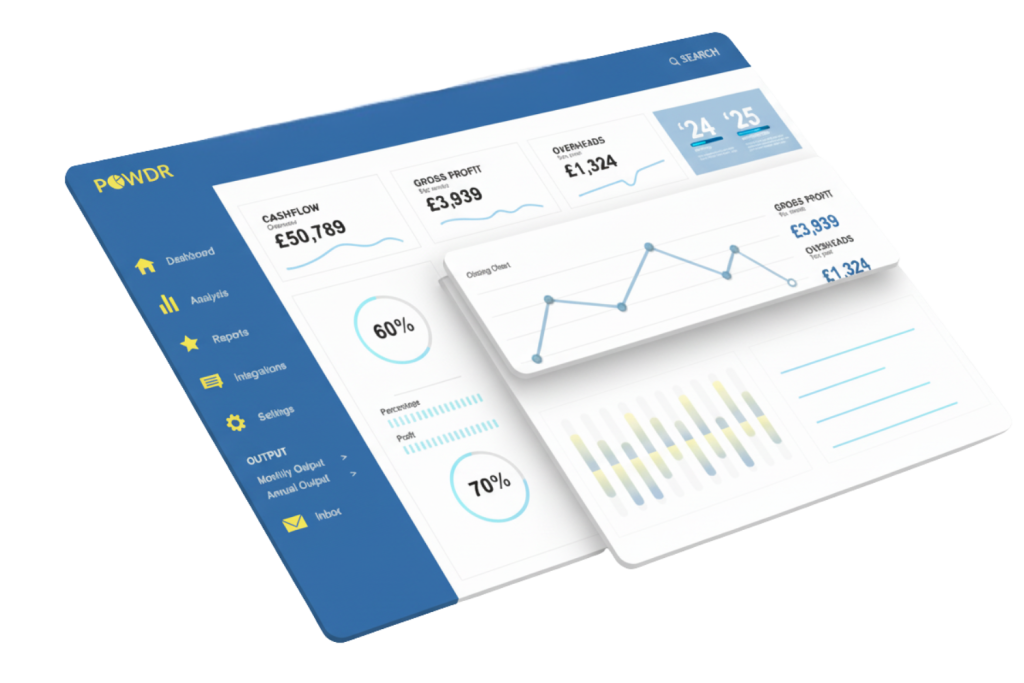
Powdr uses AI to assist with model review, assumption identification, and analysis while keeping the structural financial work in a purpose-built environment where assumptions are explicit, statements reconcile, and outputs can be trusted without a full manual audit.
What to look for when evaluating finance software
1. Assumption transparency
Any model worth using should make its assumptions explicit. If you cannot see what growth rate, margin assumption, or cost driver is baked into a projection, you cannot stress-test it. Look for software that surfaces assumptions as adjustable inputs, not as values buried in formulas.
2. Three-statement integrity
Your P&L, cash flow statement, and balance sheet need to reconcile. A revenue change should flow correctly through all three. If your finance software cannot guarantee that automatically, it is not modelling infrastructure. It is a calculator with good branding.
3. Variance analysis that runs without manual intervention
Comparing actuals to forecast should be a report you run, not a process you complete. If your current workflow involves exporting, cleaning, and reconciling data before you can begin the analysis, that is the problem to solve.
4. Multi-entity consolidation
For businesses operating across subsidiaries, divisions, or international entities, consolidation is consistently one of the most time-consuming finance tasks. Good finance software for SMEs and corporates handles this natively including intercompany eliminations, rather than requiring a separate consolidation workbook.
5. Pricing that reflects the value
Traditional FP&A consultancy is expensive. If a platform’s pricing penalises growth, that is worth understanding before you sign. Powdr’s pricing is designed to be accessible to in-house finance teams at a fraction of traditional consultancy costs.
See how Powdr handles the modelling layer
Book a call with the team and see three-statement modelling, variance analysis, and scenario planning working from a single platform.
Finance software for startups vs established businesses
The requirements differ at different stages. A startup raising a seed round needs a model that clearly communicates burn, runway, and funding scenarios. An established SME with multiple cost centres needs something that tracks covenant headroom, produces board-ready cash flow reports, and handles the complexity of a real business operating at scale.
Both need the same foundational thing: a model that moves forward as the business does, without requiring a rebuild every time something changes.
Powdr is built for both. For founders who need to forecast like a CFO without hiring one, and for finance directors who need infrastructure that matches the complexity of the business they are running.
The accountants and advisers question
Finance software for business does not just serve in-house teams. Accounting firms and finance advisers looking to build an advisory practice rather than purely compliance work need platforms that let them deliver consistent, high-quality modelling to multiple clients without rebuilding from scratch each time.
Standardised client models, recurring revenue, and the ability to scale advisory relationships are all possible when the modelling infrastructure is shared. Powdr’s platform for accountants is built around exactly that model.
The practical verdict
Finance software for business in 2026 should do one thing above all else: reduce the gap between what your numbers say and what you can actually do with them. If your current setup requires significant manual effort before a report is usable, or if your model goes stale between reporting cycles, the infrastructure is not working.
The right platform makes assumptions explicit, keeps statements reconciled, and produces the reports your board needs without a five-step export and formatting process. It should feel like infrastructure: reliable, current, and invisible in the best sense.
Powdr was built to be that infrastructure for finance teams that do not have the budget for a Big Four retainer but need the same quality of financial insight.
Ready to see it in action?
Talk to the team about your business, your current setup, and whether Powdr is the right fit.