









Choosing the right finance leadership structure is not simply a cost decision. It is a decision about how your business will be run and how much strategic value your senior finance resource can actually deliver.
Most SMEs are running their finance function on a combination of accounting software, part-time support, and a significant amount of manual effort. The actuals sit in Xero or Sage. The model lives in a spreadsheet. And somewhere between the two, the person with senior finance responsibility is spending hours every month on work that sits well below the strategic level they were hired for.
The part-time Finance Director model is designed to solve that. But with demand growing rapidly in 2026, more businesses are discovering that the model only works when the right support sits beneath it.
This article covers why the part-time FD market is growing, where the model tends to break down, and what businesses are doing to get the most from it.
What is a part-time Finance Director?
A part-time Finance Director is a professionally qualified FD typically ICAEW, CIMA or ACCA engaged for a set number of days per week rather than on a full-time basis. This might be one day a week for an earlier-stage business, or three days for a company approaching a funding round or acquisition.
The distinction from a fractional or interim FD is worth understanding. A fractional FD typically splits their time across several clients simultaneously, often with a lighter commitment to each. An interim FD is usually brought in for a specific short-term requirement. A part-time Finance Director, by contrast, is an ongoing, embedded relationship simply on fewer days than a full-time hire.
Why the demand is growing in 2026
The economics are straightforward. A full-time Finance Director in the UK now commands between £100,000 and £150,000 a year in salary alone, before pension, benefits and employer National Insurance contributions. For a business generating £2 million to £10 million in revenue, that is a significant fixed cost for a role that may not require five days of senior finance leadership every week.
A part-time arrangement delivers the same calibre of strategic thinking and financial oversight at a fraction of the cost. Businesses retain flexibility, avoid the recruitment risk of a permanent hire, and can scale the engagement up or down as their requirements change. In an environment where labour costs are the single biggest pressure cited by business leaders, that flexibility matters.
According to Adrian Lawrence at FD Capital, the part-time FD model has moved from a niche arrangement to a mainstream strategic choice. In 2026, demand is stronger than it has ever been and for good reason.
The part-time FD model is not a cost-cutting measure. It is a recognition that senior financial expertise does not need to come in a full-time package to deliver full-time value.
The constraint nobody talks about
But the model comes with a real challenge that is rarely discussed openly and one that businesses tend to discover only after the hire has been made.
A part-time FD only has a set number of days. In most SMEs, those days do not stay focused on strategy for long. When they get absorbed by modelling, investor materials and detailed financial analysis, the strategic value you brought them in for starts to get crowded out. The FD becomes a pair of hands rather than a trusted adviser and the business loses exactly what it brought them in for.
The tasks that tend to consume part-time FD days include:
- Building and maintaining financial models
- Preparing investor-ready materials and board packs
- Running variance analysis and management reporting
- Scenario planning ahead of funding rounds or significant decisions
- Producing cash flow forecasts that hold up under scrutiny
These are not low-value tasks. They are essential. But they should not be consuming the time of the most senior finance person in the business. This challenge is well documented among businesses that have adopted the model.
What good looks like
1. The execution layer is already in place
The businesses getting the most from a part-time FD are the ones that have thought carefully about what sits beneath them. Models are built and maintained properly. Reporting is structured and consistent. The materials that go in front of investors or lenders are already in good shape before the FD picks them up.
2. The FD’s days are protected for strategy
When the groundwork is handled, a part-time FD can focus on the decisions and conversations that only they can lead board-level thinking, investor relationships, commercial oversight, and the strategic calls that determine whether the business grows or stalls.
3. The combined cost still makes sense
A part-time FD supported by the right execution capability remains significantly cheaper than a full-time hire. The key is ensuring that the support layer is delivering genuine quality not just removing work from the FD’s desk and creating a different problem.
Working with a part-time FD?
Find out how Powdr can handle the financial modelling, reporting and analysis that sits beneath the strategy so your FD’s days stay focused on the decisions that matter.
Book a free callWhere Powdr fits in
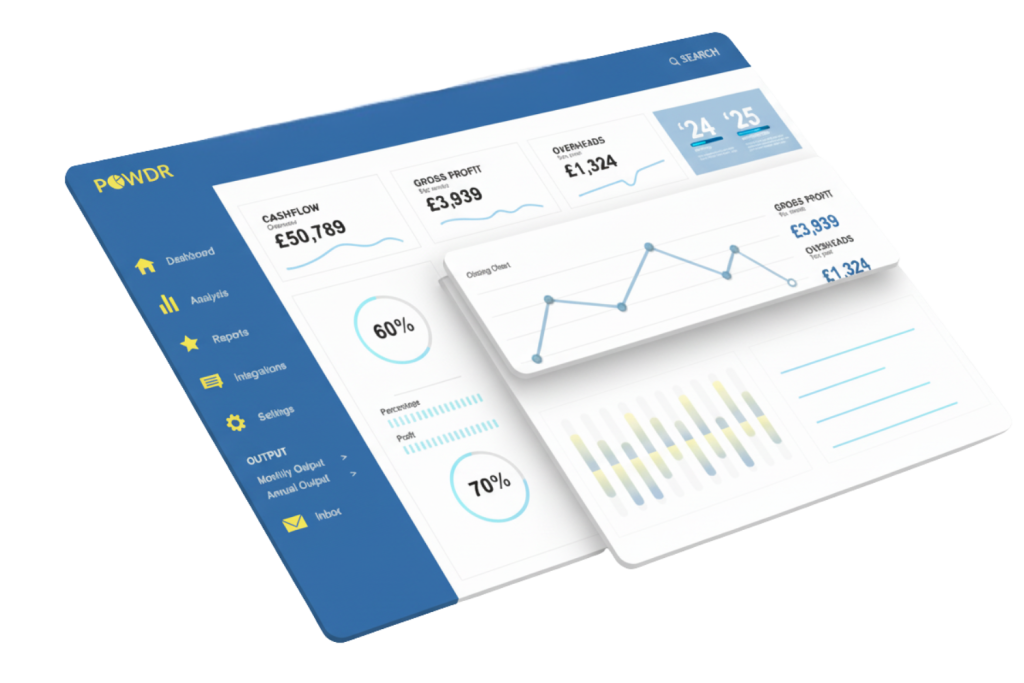
At Powdr, we work alongside part-time and fractional Finance Directors to provide exactly that foundation. We handle the financial modelling, forecasting, scenario planning and analytical work that would otherwise eat into their time built properly, structured clearly, and ready to use.
The result is a part-time FD who can operate at the level they were brought in for, supported by a finance function that holds up under scrutiny. And because Powdr combines technology with a team carrying over 150 years of combined experience across banking, FP&A and CFO roles, the cost of that support sits well below what a full-time internal hire would carry.
For SMEs navigating a difficult economic backdrop but improving access to capital, that combination experienced part-time leadership backed by the right execution capability is increasingly the most sensible way to build a finance function that is ready for what comes next.
The practical verdict
The part-time Finance Director model works. The economics are compelling, the quality of available talent is high, and for businesses at the right stage of growth it is increasingly the obvious choice over a full-time hire.
But it only delivers its full value when the right support sits beneath it. A part-time FD spending their days on execution rather than strategy is not a part-time FD it is an expensive pair of hands.
Getting that balance right is the difference between a model that works and one that quietly underdelivers. Powdr exists to make sure it works.
Ready to see it in action?
Talk to the team about your business, your current setup, and whether Powdr is the right fit.
Book a call